


Responding to Rudeness with Kindness: A Sign of Maturity and Strength
These days, it feels like we’re surrounded by stress and frustration—and it doesn’t take much for misunderstandings to turn into rude behavior. Whether it’s at work, at home, or just out in the world, we’re often confronted with this kind of behavior. And with media and social media constantly amplifying negativity, it can start to feel like rudeness and arrogance are everywhere.
Yet, how we choose to respond to this negativity defines us more than the behavior we encounter.

Building a Life of Purpose
I believe that every human being is born with a unique and meaningful purpose. We are not here by accident. Each life has value, and within that value lies potential—potential to make a difference, to touch lives, and to serve something greater than ourselves.
Yet, in the chaos of daily life—paying bills, raising families, pursuing careers—many of us lose sight of this truth. We find ourselves in a constant race for survival. And often, it’s only when life jolts us—through loss, suffering, or major change—that we pause and ask the deeper questions: What is my purpose? Why am I here?

How Volunteering Has Shaped Me
When people ask me where I’ve learned the most about leadership, I don’t immediately point to my business education or professional experience in the corporate world. I often say: “Step into a volunteer role, and you’ll find yourself learning more about leadership than you ever expected.”
Over the past years, my journey as President of Professional Women International – Brussels has been one of the most transformative leadership experiences of my life. Leading an organization built entirely on the power of volunteers, fueled by shared purpose rather than hierarchy, has taught me about vision, humility, resilience, and influence in the most profound ways.

Bridges, Not Battles: A Path to Healing What Divides Us.
Martin Luther King Jr. once marched under a banner that read:
“Men are not our enemies. If we kill men, with whom shall we live?”
He was joined in deep moral and spiritual conviction by his friend, the Vietnamese Zen master Thich Nhat Hanh. Both understood something that much of humanity still struggles to grasp to this day: Our enemies are not other people. Our enemies are hatred, anger, resentment, fear, and discrimination.
This insight is not only timely — it is timeless. And it is perhaps one of the most urgent messages our world needs to hear and integrate today.

What If Every Leader Practiced Mindfulness?
Would our world be just a little more peaceful if every leader—political, corporate, and personal—paused each day to breathe, to listen, to be?
I believe so. When the mind settles, our words soften, our choices widen, and the ripple reaches far beyond the boardroom or the living room.
Mindfulness, in plain sight
Mindfulness isn’t incense, pretzel-poses or a luxury retreat. It’s the everyday discipline of paying gentle, non-judgemental attention—to thoughts, emotions, body sensations, and the space around us—exactly as they are, right now.
Practised consistently, it re-wires stress reactions into thoughtful responses, steadies the nervous system, lowers blood pressure, and gifts us the clarity to lead with heart instead of habit.
Divisiveness and Conflict: Destroyers of Human Dignity, Depth, and Wisdom
We are living through a time where polarization seems to dominate headlines, conversations, and communities. And yet, beneath the noise, there is something far more precious being quietly eroded: our human dignity, our capacity for depth, and our collective wisdom.
It’s easy to overlook the true cost of conflict in a world that often rewards the loudest voice or the sharpest retort. But if we pause and pay attention, we begin to see the damage—both subtle and profound—that division inflicts on our shared humanity.

Leadership and Decision Making: The Quiet Power of Critical Thinking and Intuition
Have you ever found yourself awake in the still of the night, your mind looping over a difficult decision? If you have, you’re not alone.
Leadership often means navigating complexity—and with that comes moments of doubt, uncertainty, and the quiet weight of responsibility. Decision making is a vital skill, and history is full of examples showing just how impactful—positively or negatively—our decisions can be.
While mistakes are part of any leader’s journey, how we learn from them, how we pause to reflect and grow, is where our true strength lies. And that’s where critical thinking becomes such a powerful ally.
But for me, it doesn’t stop there.
Peace Begins Within
Every day, we are confronted with new headlines—more violence, more war, more division. From the renewed tensions between India and Pakistan, to the devastating wars between Russia and Ukraine, Israel and Palestine, to the ongoing suffering in Sudan and Yemen—we are witnessing a world that seems to have forgotten one fundamental truth:
Outer peace is impossible without inner peace.

You Are Not What Others Project: Reclaiming Your Inner Worth
There’s something profoundly liberating about not allowing others to determine your worth.
Yet it’s also one of the most challenging mindsets to cultivate—because from a young age, many of us have been conditioned to seek validation outside of ourselves. A raised eyebrow, a dismissive tone, a judgmental look… all these small cues can sometimes plant seeds of self-doubt.
But here’s the truth: No one has the power to define your value—unless you hand it over to them.
When someone tries to make you feel inferior, it says more about their internal world than about your essence. Their words or actions may stem from insecurity, fear, jealousy, or even unconscious bias. Seeing this doesn’t excuse harmful behavior, but it does help us to not internalize it. That is a powerful shift.

Finding Fulfilment through Letting Go: the Transformative Power of Kindness and Forgiveness
Over the years, I’ve met many people carrying the weight of unspoken hurt—some even struggling with anxiety or depression. Often, beneath their suffering lies a quiet burden: the pain of unresolved anger, bitterness, or disappointment. These emotional wounds, left unattended, begin to shape our outlook, our relationships, and even our physical health.
But I’ve also witnessed something remarkable: how healing begins the moment we choose to let go. And how kindness, extended to ourselves and others, can guide us there.

How Kindness Shapes Tomorrow’s Leaders
Look around, and you’ll see it everywhere—rudeness in public discourse, merciless competition in workplaces, and a growing disconnect between leaders and the people they serve.
In a world that often rewards aggression over empathy, leadership driven by kindness and compassion is not just a preference—it’s a necessity.
True leadership isn’t about exerting control or demanding results at any cost. It’s about inspiring people, fostering trust, and creating environments where individuals can thrive. The most impactful leaders throughout history—those who left legacies of transformation—led not through intimidation, but through empathy, wisdom, and a genuine concern for others.
Kindness in leadership is not weakness. It is strength. It is the foundation of trust, collaboration, and growth. Leaders who embrace kindness don’t just manage teams; they mentor, uplift, and empower people to become the best versions of themselves. And in doing so, they shape a future where leadership is not about power, but about purpose.

The Kindness Revolution: How Kindness and Compassion can Conquer Hate and Transform the World.
A few days ago, I saw a documentary on the Al-Hawl Refugee Camp in northern Syria. And it is so obvious and still heartbreaking to watch how hate, revenge and hard-heartedness are cultivated and growing there. And I am sure in many other places where atrocities take place. Whole new generations grow up traumatized and full of hatred. In our close surroundings too, we can witness hate or ourselves be carried away by hate.
Hate is a pernicious poison that's been destroying countless lives. The question remains: why haven't we found a way to transcend hate knowing that kindness can be a more powerful tool in the journey of life? [Rhetoric].
Isn't it time to break free from the cycle of hate and start building bridges instead of walls? Hate has caused many to lose opportunities in life, and it's time to break this cycle. We can break this cycle of hate by simply by realizing that hatred destroys the hater.
Rising above Self-Doubt: A Transformative Journey to Discovering Your Inner Strength
Do you often find yourself held back by self-doubt? You're not alone. Many of us possess the innate ability to reach extraordinary heights, yet self-doubt often holds us back from achieving greatness. When we allow doubt to cloud our minds, we diminish our capacity for success. It's time to break free from this limiting mindset and unlock your true capabilities.
Throughout history, remarkable individuals have attributed their accomplishments to an unshakeable belief in themselves. From visionary leaders to pioneering innovators, their journeys to success were marked by a steadfast confidence that overshadowed fear and doubt.
By embracing this mindset, we can overcome fear and doubt, and achieve remarkable things. Remember, confidence is the catalyst for greatness – let it propel you towards your dreams.
The Power of Humility and Kindness in Leadership
Humility and kindness often have become rare gems in a world where leadership qualities like decisiveness and charisma often take the spotlight.
Yet, it is precisely these traits that can set exceptional leaders apart, creating a lasting impact on their teams and organizations.
In this article, we explore how the seemingly soft skills of humility and kindness have a profound influence on leadership effectiveness. By embracing these virtues, leaders can build trust, nurture inclusivity, and cultivate a positive organizational culture that thrives on compassion and collaboration.

Kindness: The Missing Link to Mental Health at Work
“Kindness fills and envelops you in authenticity that will make a greater first impression in seconds than you ever could without being kind.” - Adrienne Bankert
There’s something profoundly liberating about not allowing others to determine your worth.
Yet it’s also one of the most challenging mindsets to cultivate—because from a young age, many of us have been conditioned to seek validation outside of ourselves. A raised eyebrow, a dismissive tone, a judgmental look… all these small cues can sometimes plant seeds of self-doubt.
But here’s the truth: No one has the power to define your value—unless you hand it over to them.
When someone tries to make you feel inferior, it says more about their internal world than about your essence. Their words or actions may stem from insecurity, fear, jealousy, or even unconscious bias. Seeing this doesn’t excuse harmful behavior, but it does help us to not internalize it. That is a powerful shift.

Kindness as an evolved way of Being
It is my mission to shift the current perspective on Kindness and teach that Kindness is an evolved way of Being, that kindness is only perceived as weakness by the weak, the imbalanced and the insecure (and let’s never lose our compassion for them).
It requires self-discipline and a very strong sense of self-understanding, self-confidence and self-esteem to stay kind to a rude person, to stay outside the negativity of the unkind one, and to not be triggered by it.
Kindness is a sign of a person who has dealt with his inner demons, his insecurities and old wounds, who has done a lot of personal work and has come to a great self-understanding, a deep compassion and wisdom.
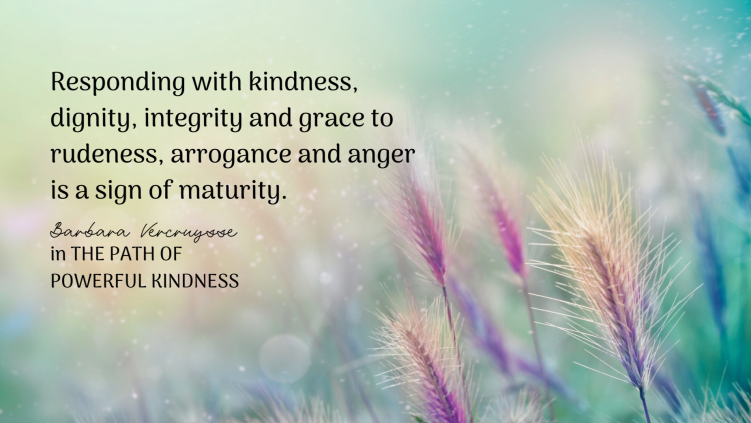
Responding to Rudeness with Kindness: A Sign of Maturity and Strength
In today’s world, it’s easy to get caught up in the stress, frustrations, and misunderstandings that lead to rude behavior. Whether it’s in the workplace, at home, or in public, rudeness seems to have become an unfortunate byproduct of modern life.
Yet, how we choose to respond to this negativity defines us more than the behavior we encounter.
One of the core principles I explore in my book, The Path of Powerful Kindness, is the transformative power of responding with kindness, even in the face of rudeness. It may seem counterintuitive at first, but kindness is not weakness. In fact, it requires great strength and emotional maturity.

Pitfalls of Perfectionism - Shift to Excellence
In our relentless pursuit of greatness, many of us find ourselves entangled in the suffocating web of perfectionism.
We strive to project an immaculate image, often at the expense of our mental well-being. This unyielding quest for perfection can lead to a life plagued by constant stress, anxiety, and even depression.
Yet, by acknowledging the damaging nature of perfectionism and embracing our imperfections, we can liberate ourselves from its confines and foster a deep sense of self-acceptance and self-love.
Perfectionism is often rooted in profound fears of inadequacy, rejection, and failure, creating a cycle of relentless self-criticism as we chase an unattainable ideal. It is time to challenge this mindset.
By embracing our mistakes, practising mindfulness, and cultivating self-compassion, among other key strategies, we can break free. The journey towards self-acceptance is a journey towards a more fulfilling and meaningful life.
Strive for Excellence, not Perfectionism. - H. Jackson Brown Jr.
Repurposing Your Broken Pieces for Fulfilment
The journey of life comes with setbacks, obstacles, and moments of doubt that can leave us feeling broken because we often get unprepared for the unexpected turns that it throws at us.
If we look at success and failure more closely, we can see that success and failure are two sides of the same coin, what seems as success for one person might be a failure for another.

Finding Balance in the Eye of the Storm: a Path to Inner Peace
Life is a magnificent adventure, full of twists and turns that can leave us breathless. Yet, the journey seems effortless for some, while others struggle to find their footing.
It's crucial to recognize that life's challenges are inevitable, but it's how we respond that truly matters. These challenges, whether they be chronic illness, job loss, the death of a loved one, divorce, or other adversities can leave us feeling lost and hopeless.
Much love, Barbara